WHO Urges Immediate Action as Ebola Outbreak Expands in the Democratic Republic of the Congo
The Director-General of the World Health Organization (WHO) has urged neighboring countries to take immediate action as the Ebola outbreak in the Democratic Republic of the Congo (DRC) continues to spread faster than current response efforts. WHO warned that the outbreak is outpacing the capacity of public health authorities and poses a significant risk to neighboring countries.
Dr. Tedros Adhanom Ghebreyesus, WHO Director-General, stated, “We are urgently scaling up operations, but at the moment the epidemic is outpacing our response efforts.” He called on neighboring countries to strengthen preparedness and response measures without delay.
Speaking during an online African Union meeting on the outbreak, Dr. Tedros reported that 220 suspected Ebola-related deaths had been recorded in the current outbreak. He also announced that he would travel to the DRC on Tuesday together with Dr. Chikwe Ihekweazu, Executive Director of WHO’s Health Emergencies Programme.
The announcement comes amid ongoing insecurity in Ituri Province, the epicenter of the outbreak, where attacks on healthcare facilities have disrupted disease control efforts. Residents of Mongbwalu town attacked Mongbwalu General Referral Hospital on both Saturday and Sunday.
Dr. Richard Lokodu, Medical Director of the hospital, told Reuters that 18 Ebola patients fled the facility on Saturday after unidentified individuals set fire to isolation tents established by Médecins Sans Frontières (MSF). He further reported that the hospital was attacked in four separate waves on Sunday by groups of young people mobilized by relatives of a religious leader who had died from Ebola. During the unrest, seven additional patients escaped, requiring Congolese police and military personnel to intervene and restore order.
One suspected Ebola patient in critical condition with hemorrhagic symptoms died while attempting to flee from his hospital bed during the second attack. According to reports, the attackers demanded the release of Ebola victims’ bodies so that traditional burial ceremonies could be conducted.
In a similar incident on Thursday, a crowd set fire to an Ebola treatment center in Rwampara, near Bunia, after authorities refused to release the body of an Ebola victim to family members for burial.
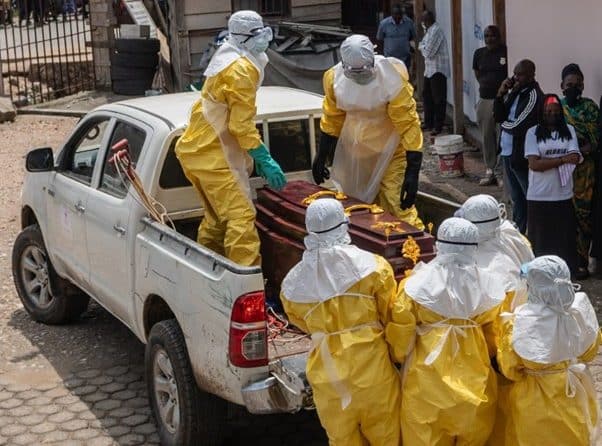
The handling of Ebola victims’ bodies, which may remain highly infectious after death, is strictly managed by public health authorities to prevent further transmission. However, some families continue to prefer traditional burial practices that involve washing and touching the body. Previous Ebola outbreaks have demonstrated that such practices can play a major role in disease transmission.
Earlier this month, Dr. Tedros declared the outbreak a Public Health Emergency of International Concern (PHEIC) after more than 300 suspected cases and 88 deaths were reported in the DRC, along with two Ebola-related deaths in neighboring Uganda.
On Monday, Uganda’s Ministry of Health announced two additional Ebola cases, bringing the country’s total number of confirmed cases to seven. Both newly reported cases involve healthcare workers from a private health facility in Kampala, the capital city of Uganda.
The current outbreak is caused by Bundibugyo ebolavirus, a relatively rare Ebola virus species for which no approved vaccine or treatment is currently available.
Major outbreak hotspots include Rwampara, Mongbwalu, Nyankunde, and Bunia in Ituri Province in northeastern DRC. The region serves as a major trade and migration corridor and is rich in gold deposits. It has also experienced long-standing conflict between armed groups associated with the Hema and Lendu ethnic communities, competing over land and mineral resources. The violence has resulted in more than 50,000 deaths since 1999.
Additional Ebola cases have been reported in Butembo and Goma in North Kivu Province, as well as Bukavu in South Kivu Province, some of which remain affected by ongoing armed conflict.
Dr. Tedros noted that outbreak control efforts continue to be complicated by insecurity in Ituri and North Kivu provinces, population movement, and the absence of an approved vaccine against Bundibugyo ebolavirus.
This report includes information contributed by Reuters.